Objective
Become self-aware of psychological biases that will cloud your judgement. Learns strategies to recognise and address our own biases.
Motivation
Make better decisions, particularly when emotions are involved.
Prerequisites
This is a fairly complex and challenging topic and requires an open mind, maturity, courage and temperance. It’s recommended that it’s not attempted until at least 15 years of age. The resources include some fairly advanced books so very good reading ability is required.
It’s also recommended that you’ve practiced the virtues by achieving relevant milestones:
Courage: You’ll need courage to challenge yourself. Accepting that you may be wrong takes serious courage.
Temperance Milestones: This is a tough skill to even understand, let along begin to practice. You’ll need discipline to work through the resources and the suggested Initiation Path.
Humility: Having an open mind about your own possible fallacies requires a lot of humility.
Resources
Mentors
Media
Introduction:
- Web Page: What is Cognitive Bias? 7 Examples & Resources by Alicia Nortje
- Video: Cognitive biases: science says we’re smart stupid, not stupid stupid video by Anya Turnbull. Good summary in very easy to understand language.
- Video: The Psychology behind Irrational Decisions. Sara Garofalo. Another summary, a little more technical with an economics focus.
- Video: The counterintuitive way to be more persuasive by Niro Sivanthan. Specific Summary of the Dilution Effect with details of the experiments that prove it occurs.
Advanced:
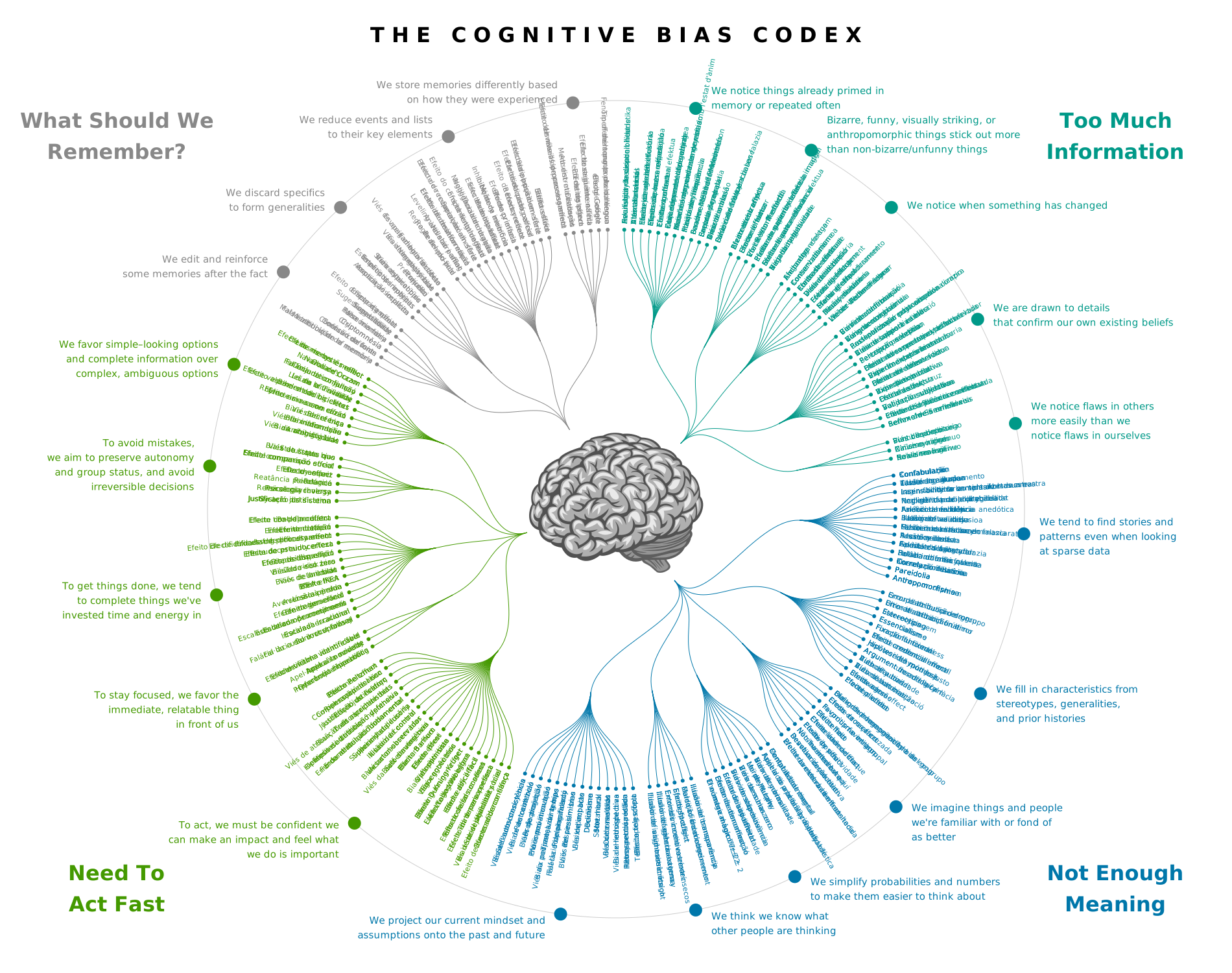
- Cognative Bias Codex (see diagram below). Comprehensive list of cognitive biases grouped by their effect on our decision making. The diagram is interactive with links through to detailed wikipedia articles on each bias.
- Book: Thinking Fast and Slow by Daniel Kahneman
- Book: The Undoing Project by Michael Lewis
- Book: Poor Charlie’s Almanack: The Essential Wit and Wisdom of Charles T. Munger by Charles T. Munger (Author), Peter D. Kaufman (Editor), Warren E. Buffett and John Collison
- Course: Master Cognitive Biases and Improve Your Critical Thinking – Udemy Course delivered by a psychologist
- Course: The Complete Cognitive Bias Guide: Buffett & Munger’s Secret – Udemy Course delivered by and Entrepreneur
Cognitive Bias Codex: Diagram by John Manoogian III categories and descriptions: Buster Bensonimplementation: TilmannR, CC BY-SA 4.0 https://creativecommons.org/licenses/by-sa/4.0, via Wikimedia Commons
Suggested Track
Human nature basically dictates that you’ll always be susceptible to cognitive biases (actually, not just susceptible, but effected in a way that will be detrimental to good decision making). So the real journey is life-long. The Initiation Track is about:
- Education: Watching and reading the resources to become educated about psychological biases.
- Reflection: Using a journal to reflect on decisions (or reactions to new information) and reflect on how you may have been influenced by psychological biases.
- Practice: Likely the best way to initially practice countering psychological biases is when considering an important but non-urgent decision where you have the time (and motivation) to run through a checklist of common biases and consider how they may be affecting your decision making process.
Skill Milestones
It’s not possible to “Master” the recognition of psychological biases in yourself. That’s the whole problem of psychological biases! What you can do though is learn how to use systems to make better decisions.
- Watch and read the “Introduction” resources.
- Start journalling with a specific focus on reflecting on the following:
- How decisions you made during the day may have been effected by cognitive biases (if you’re not identifying any you’re not recognising them, because they’re at work!!)
- How your reactions (particularly emotional reactions) may have been effected by cognitive biases
- During the journeying process read “Thinking Fast and Slow” by Daniel Kahneman. This will explain the science in detail and help you make better decisions
- Read Poor Charlie’s Almanack. Create your own list of “Causes of Human Misjudgement” like Charlie’s in the appendix of his book. Lean on your journalling as you may have already identified some that have come up often in your own decision making (or emotional responses) to things.
- Approach a big decision systematically by running through your list of “Causes of Human Misjudgement” and take the time to write down how each of these may be clouding your initial intuition on the decision. Adjust your reasoning accordingly and reconsider the best decision to take.
- Keep practicing this technique until it becomes easier and more streamlined (be wary, this may just be Automation Bias!!).
With practice you should start to notice consideration of your own biases without the help of your checklist. For example, you may reflect on a decision or reaction and realise the biases that may have been at play, or better still, recognise during the decisions making process, or as you are responding to something that a particularly bias may be clouding your mind. When you get to this point you know you’ve completed the milestone for this skill. Note that you’ll need to keep practicing to maintain the skill. But setting up this mindset early will hopefully build the neural pathways that will make you a better decision maker and more capably of reacting calmly and rationally to potentially emotive information.